Palou’s dominance continues in Grand Prix, but can he solve Indy 500 puzzle?
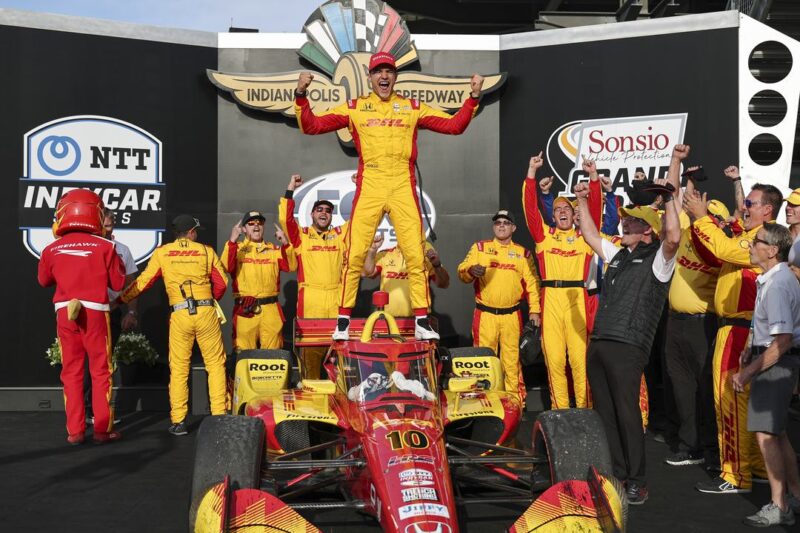
SPEEDWAY – Another IndyCar race, another runaway victory for Alex Palou.
The Spaniard stalked Graham Rahal for the first three-quarters of Saturday’s Sonsio Grand Prix at Indianapolis Motor Speedway, made his move with 27 laps remaining and pulled away for a nearly six-second victory over Pato O’Ward.
It’s the fourth victory for Palou in the season’s first five races, the greatest opening run in the series in 20 years.
Up next?
The Chip Ganassi Racing superstar will get the chance to check the one remaining box on his increasingly historic resume – a win in the Indianapolis 500 on May 25.
“If that happens, I’ll get crazy – like, very crazy,” Palou said. “If that doesn’t happen, we will see. But if that happens – I don’t know.
“Yeah, things are going to fly. Flames here, flames there. It’s going to be amazing.”
Saturday’s victory was the third at IMS for Palou, who also won the Grand Prix in 2023 and 2024. He finished second in the Indy 500 in 2021 and won the pole position in 2023, but he’s yet to drink the milk in Victory Lane following The Greatest Spectacle in Racing.
In fact, none of his 15 career IndyCar victories have come on an oval.
But the 28-year-old is already being compared to all-time IndyCar great A.J. Foyt and can’t be counted out at the Brickyard in two weeks.
“Everything we do is about building momentum for the 500,” Ganassi Racing team manager of competition Barry Wanser said. “The Indy 500 – it’s out goal. It’s one of our two goals. It’s to win the Indy 500 (and) win the (season points) championship.
“Everything we do at the beginning of the year is to build momentum for that.”
The late Dan Wheldon won four of the first five races in 2005 – including the Indianapolis 500 – and Sebastian Bourdais won the first four races of 2006. But both those feats were accomplished during the American open-wheel split.
Wheldon’s run came in the fledgling Indy Racing League, while Bourdais’ came in the defunct CART series.
A case can be made Palou’s feat is the most impressive since Foyt won six of the first seven races and eight of 12 for the season in the USAC Championship Car series in 1964.
“I said (to Palou), ‘Man, I’ve been around a long time, and in this field, in this time, it is amazing to see something like that,’” Saturday’s third-place finisher Will Power said. “It really is. It is incredibly tough just to win a race in IndyCar now.”
Power understands the difficulty – and satisfaction – of winning the Indy 500 as well as anyone.
He has 44 career race victories, 70 career starts on the pole, two IndyCar points championships and four wins in Grand Prix races at Indianapolis Motor Speedway.
But his only win in the 500 came in 2018, the 11th of his 16 starts in IndyCar’s marquee event.
“Winning that thing is such a big deal,” Power said. “It just is. It’s extremely hard to win, extremely hard to put yourself – you really have no clue how it’s going to play out for you until like 20 (laps) to go or something.
“It’s always that way, which makes it a very exciting race.”
O’Ward – another of IndyCar’s brightest young stars – has finished as the runner-up in the 500 to Power’s Team Penske teammate, Josef Newgarden, in each of the past two years.
He’s made no secret of his desire to win the year’s biggest race, and he jokingly interrupted Wanser’s session with the media to yell “slow down” while awaiting his turn at the podium.
As impressive as Palou’s dominance has been – he finished second in the lone race he didn’t win this year – it’s no guarantee he’ll get over the hump in the 500.
“Oh, yeah,” O’Ward said. “(The) Indy 500 is it’s own beast.”
Even amidst his third straight Grand Prix victory celebration Saturday, Palou admitted his golden run can’t last forever.
Indy 500 veterans are fond of saying the track chooses the race winner each year.
It’s their way of acknowledging the unpredictable – almost random – nature of the event.
It’s an endurance race that tests drivers as much mentally as it does physically, and that’s before taking the mechanical and technical challenges into account.
The pressure is intense. One false move by any member of a race team can spell disaster, and even a nearly flawless performance isn’t immune to the whims of pure luck.
Palou openly admits his dominance could end in the one race he wants to win the most.
But it doesn’t mean he accepts it as a fait accompli.
“I mean, there’s high chances of that, but hopefully you can change it,” he said. “What if it doesn’t end, and suddenly we win the Indy 500? That would be pretty sweet.
“The normal thing would be not to win it. So if we can make it happen, it would be super special.”